

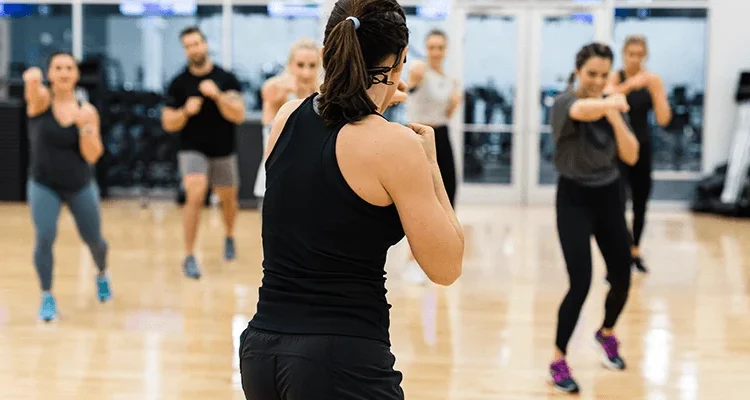
Guard position may appear to be the pause between punches. In practice, it is an active position that organises the shoulders, hands, trunk and stance before the next movement.
During a BODYCOMBAT class, returning to guard creates consistency across combinations. It also develops shoulder endurance and helps participants recover from each strike without losing balance.
Guard Is a Reference Position
Fast combinations contain many moving parts. A repeatable guard gives the participant a known position to return to.
From guard, the hands are prepared to punch, the elbows remain organised and the trunk can rotate in either direction. The participant does not need to search for the starting position of every strike.
Without a reliable reference, combinations can become progressively wider and less predictable.
Guard therefore supports both movement quality and learning.
Hand Height Affects Shoulder Work
Holding the hands near the face or upper chest requires the shoulders to work continuously.
If the hands are held unnecessarily high, the shoulders and neck may fatigue quickly. If they drop too low, the return pathway becomes longer and the intended movement pattern changes.
The exact position varies with the combination and participant. The hands should be high enough to create a clear guard without forcing the shoulders towards the ears.
At True Fitness Singapore, participants can follow instructor demonstrations while adjusting within a controlled range.
Elbow Position Protects Efficiency
Elbows held excessively wide increase shoulder demand and may make straight punches less direct.
Keeping the elbows reasonably organised near the torso can make guard more economical. This does not mean pressing them tightly against the ribs.
The elbows need enough freedom for hooks, uppercuts and defensive movements. They should move according to the strike and return without remaining permanently flared.
Efficient guard position reduces unnecessary tension between combinations.
The Fists Should Be Firm but Not Crushed
A loose hand does not provide a clear striking shape. Constant maximum gripping creates unnecessary forearm and shoulder fatigue.
Participants can form the fist securely while avoiding excessive tension. The wrist should remain aligned rather than bending sharply during punches.
Because BODYCOMBAT is non-contact, the participant does not need to brace for impact with a physical target. The focus is movement control.
Nails and jewellery should also be considered. Hands need to close comfortably without causing pressure or injury.
Guard Connects to the Trunk
The hands may define the visible guard, but the position begins from the stance and trunk.
The participant should feel balanced enough to move forwards, backwards or sideways. Excessive leaning makes it difficult to strike and recover.
A lightly organised trunk supports arm movement without becoming rigid. If the participant holds the body completely stiff, rotation becomes limited and the shoulders may work harder.
Guard is therefore a whole-body position, not just a place to park the hands.
Guard Supports Deceleration
After a punch, the hand needs a clear destination. Returning to guard gives the shoulder and upper back a defined braking task.
If the hand drops randomly after each strike, the participant must lift and reposition it before the next movement. This increases work and disrupts timing.
A controlled return allows combinations to flow. It also prevents momentum from pulling the trunk excessively.
The return should be quick but not tense.
Fatigue Usually Lowers the Guard
As shoulder endurance declines, the hands gradually move downwards. The participant may still complete punches but begins every movement from a lower position.
This increases the distance required to return and can alter the rhythm of the combination.
Instructors may cue “hands back to guard”, but the participant must decide whether the issue is attention or fatigue.
If the shoulders can no longer support the position, reducing punch range or speed may be more effective than repeatedly forcing the hands upwards.
Guard Should Not Create Neck Tension
Participants sometimes interpret guard as a shrug. The shoulders rise, the neck shortens and the upper body becomes rigid.
A more sustainable position keeps the shoulders active without constantly lifting them. The head remains balanced over the trunk.
Briefly shaking out unnecessary tension during an appropriate transition can help. The participant should then rebuild guard before the next combination.
Persistent neck discomfort should not be ignored or treated as a normal requirement of the class.
Guard Changes With Movement Direction
A front-facing sequence, staggered stance and side-directed combination may require slightly different guard orientation.
The hands can move with the torso while maintaining their relationship to the body. They should not remain facing forwards when the entire stance has turned.
During knees or kicks, the arms may also move to support the pattern. They should return to guard when the combination requires it.
Guard is adaptable rather than frozen.
Defensive Style Should Not Be Confused With Fighting Instruction
BODYCOMBAT uses martial arts-inspired movements in a non-contact fitness format. Guard position supports choreography, endurance and movement organisation.
It should not be treated as complete instruction for physical confrontation or self-defence.
Real combat situations involve contact, distance, reaction and risk that cannot be reproduced through fitness choreography alone.
The class benefit lies in conditioning and coordinated movement.
Improving Guard Without Overthinking It
Participants can focus on three practical checks: relaxed shoulders, controlled elbows and consistent hand return.
Trying to correct every joint simultaneously may reduce class flow. One cue can be selected for each track.
Video may help when recorded with facility permission, but the participant should avoid judging guard solely from one frozen image. Movement quality is better assessed across the full combination.
Frequently Asked Questions
Q: How high should my hands be in guard?
A: Generally near the face or upper chest, depending on the combination. They should remain controlled without forcing the shoulders towards the ears.
Q: Why do my hands drop during later rounds?
A: Shoulder fatigue and reduced attention can both contribute. Reduce range or speed if you cannot restore guard comfortably.
Q: Should my fists remain tightly clenched?
A: Keep them secure but avoid maximum gripping throughout the track. Excess tension can fatigue the forearms and shoulders.
Q: Can guard position prevent shoulder pain?
A: Efficient guard may reduce unnecessary tension, but it cannot prevent every problem. Persistent pain requires appropriate assessment.
Q: Does BODYCOMBAT teach practical self-defence?
A: It is a non-contact fitness programme. Its guard and strike patterns support exercise, not complete real-world self-defence preparation.
